
Are Those Flying Ants or Termite Swarmers? What New Jersey and New York Homeowners Need to Know This Spring
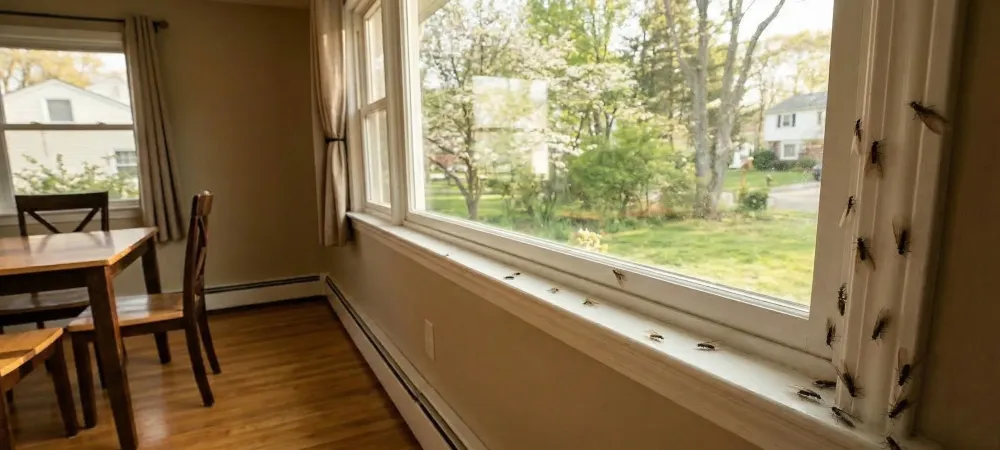
You walk into your living room and find a cluster of winged insects crawling near a window frame. Your stomach drops. The question that follows is the one that really matters: are these termites or just ants? Getting the answer right determines everything that comes next, from the urgency of treatment to the size of the repair bill. In New Jersey and New York, spring is the season when that question demands an immediate answer.
Quick Answer: If you spot winged insects near windows or door frames in the spring, treat it as a termite concern until you can confirm otherwise. Termite swarmers have equal-length wings, a thick straight waist, and beaded antennae, while flying ants have uneven wings, a pinched waist, and elbowed antennae. The distinction matters because termites signal an active colony and require professional treatment right away.
What You Need to Know Right Now
- Spring swarmers near windows in New Jersey and New York almost always point to Eastern subterranean termites, which swarm from late March through May after rain and warm temperatures.
- You can identify the difference in seconds using three physical checks: body shape, wing length, and antennae bend.
- Seeing swarmers indoors indicates a nearby mature colony is already active. Swarmers do not cause the structural damage, but they are a sign that worker termites already are.
Why Spring Swarmers in New Jersey and New York Are a Red Flag You Cannot Ignore
New Jersey and New York sit in what the pest management industry classifies as a moderate-to-heavy termite infestation zone. The Eastern subterranean termite (Reticulitermes flavipes) is the only species that causes structural damage in our region, and it uses swarmers, also called alates, to expand. These are winged reproductives that leave a mature colony to find a mate and start a new one.
According to Rutgers Cooperative Extension entomologist Changlu Wang, "hundreds or thousands of swarmers leave the nest during warm sunny days between April and June," and this is "when most homeowners first notice termites in their homes". The trigger is usually a warm day following rainfall, with soil temperatures climbing into the 60 to 70 degree range. In our area, that window opens as early as mid-March along coastal areas and runs into June in the cooler northwestern counties.
Flying ants are a different story. Most ant species, including carpenter ants, swarm in late spring and summer, not in March or April. In our experience, when a homeowner calls us about swarmers in late March or April after a rainy stretch, it is termites, not ants. If you are seeing swarmers right now, this spring, lean toward termites until a professional tells you otherwise.
Knowing what has been quietly happening inside your walls all winter is part of understanding the risk. We cover that in more detail in our post on the importance of termite prevention in winter.
How to Tell Them Apart: The Three-Check Method
You do not need a microscope or a pest control license to make this identification. If you can get a look at the insect, three physical checks will give you a clear answer most of the time.
Check 1: The Body (Waist Shape)
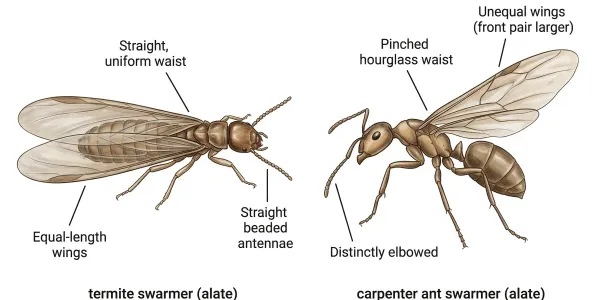
This is the most reliable check. A termite swarmer has a thick, uniform body with no visible pinch between the midsection and abdomen. The segments flow together into a single tube-like form. An ant swarmer has a distinctly pinched waist, the narrow hourglass connection between the thorax and abdomen that you can clearly see even on a small insect. Rutgers Cooperative Extension describes the termite's abdomen as "joined snugly to the thorax, without a node or waist," while the ant's abdomen is "distinctly separated from the thorax by a very small node or thin waist". If there is a clear pinch, it is an ant. If the body looks uniform, assume termite.
Check 2: The Wings
Termite swarmers have two pairs of wings that are nearly identical in length, both extending well beyond the body. They are also flimsy, and termites shed them almost immediately after landing. Finding small, equal-length wings piled on a windowsill or near a door frame is one of the most common signs we investigate. Ant swarmers, by contrast, have unequal wings. The front pair is noticeably larger than the hind pair, and ants hold their wings rather than shedding them right away. If you find a pile of wings near a window and the insect itself is gone, that is a strong termite indicator.
Check 3: The Antennae
Termite antennae are straight and beaded, almost like a tiny string of pearls running forward from the head. Ant antennae are elbowed, meaning they have a distinct bend partway down. If you can get close enough to see the antennae, this check is decisive. We have found this the easiest check to explain to homeowners over the phone when they need a quick answer before the pest disappears.
The Carpenter Ant Exception: When Ants Are Also a Structural Problem
Flying ants are generally a nuisance, not a threat to your home's structure. There is one important exception: the carpenter ant. These are the largest ants you will find in New Jersey and New York, often black or bicolored, and they are wood-destroyers in their own right.
Carpenter ants do not eat wood the way termites do. Instead, they excavate it to build their nesting galleries, preferring damp or water-damaged wood near leaks, roof penetrations, or poorly ventilated crawl spaces. The damage accumulates more slowly than that from a termite infestation, but, left unchecked, carpenter ant galleries can compromise structural members, especially around window frames, sill plates, and roof eaves.
When carpenter ant swarmers emerge, typically in late spring or early summer, the body shape and wing check still apply. Carpenter ants will have that pronounced pinched waist and unequal wings. You may also find frass nearby, which looks like coarse sawdust and sometimes contains insect body parts or discarded wings. Termite frass from subterranean species is not commonly found in the same way, since subterranean termites use their waste in mud tube construction. If you see sawdust-like material near structural wood, it points more toward carpenter ants than termites.
Swarmers Indoors Mean a Colony Is Already There
This is the part that catches homeowners off guard. The swarmers themselves are not the ones doing the structural damage. Worker termites, which are white and wingless and almost never seen, are the ones chewing through the wood around the clock. Swarmers emerge from a mature colony, and a colony does not produce swarmers until it has been established for several years and grown to a significant size.
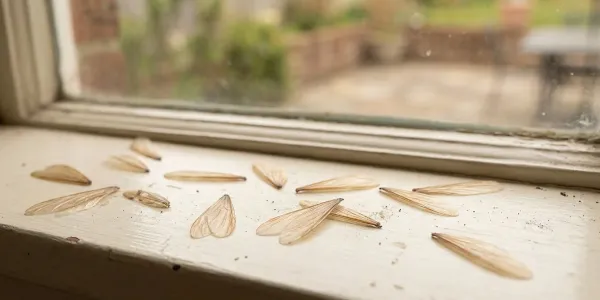
Finding swarmers inside your home, especially emerging from walls, floor joints, or light fixtures, rather than just drifting in through an open window, is a strong sign that a colony has already established itself within or beneath your structure. As the EPA notes, finding termite swarmers indoors is evidence of an active infestation that warrants immediate professional inspection. If you find discarded wings near a windowsill or door frame, that is the same alarm in a smaller package. Understanding what attracts termites to your home in the first place can help you assess your own property's vulnerability.
We have inspected properties where the homeowner swept up the swarmers and assumed the problem resolved itself. In most of those cases, the colony was still very much active.
Other Signs That Confirm What You Are Dealing With
When you find swarmers, check the rest of the structure for supporting evidence. With termites, look for mud tubes, those pencil-thin tunnels of dried soil running along your foundation walls, basement joists, or crawl space framing. They are the Eastern subterranean termite's highways between the soil colony and the wood it consumes. Wood that sounds hollow when tapped with a screwdriver is another telling sign. If the wood surface looks intact but feels soft or crumbles inward when probed, termites have been working from the inside out.
With carpenter ants, you will often see the frass deposits described above, and you may hear a faint rustling or crackling from inside wall voids, especially at night when the ants are active. Entry points tend to be near moisture sources, such as a dripping gutter, a leaky pipe chase, or deteriorating fascia board.
Prevention Steps That Reduce Your Risk This Spring
You cannot always stop swarmers from appearing in the area, but you can make your home a less attractive target for colony establishment. Along with being aware of the pests that stay active in and around your home all season long, these prevention steps are worth doing now, before peak swarm season hits:
- Keep mulch and soil pulled back at least six inches from the base of your foundation. Wood-to-soil contact is one of the most common entry points for subterranean termites.
- Fix any moisture problems promptly. Leaking gutters, condensation in crawl spaces, and improper grading that allows water to pool near the foundation all create the conditions termites and carpenter ants need.
- Store firewood off the ground and away from the house, at least 20 feet from the structure if possible.
- Seal foundation cracks, gaps around pipe penetrations, and deteriorating window frames to close off both termite entry points and carpenter ant access.
- Keep tree branches and shrubs trimmed back from the roofline and siding so ants cannot use them as a bridge to reach the structure.
- Schedule a professional termite inspection annually, not just when you see swarmers. Infestations can be active for years before visible signs appear.
When to Stop Waiting and Call for an Inspection
If you see winged insects emerging from inside your home, rather than from outdoors, call for an inspection the same day. Do not treat before you know what you have. Termite treatments and ant treatments require completely different approaches, and using the wrong product at the wrong time can scatter a termite colony further into a structure rather than eliminating it.
The same urgency applies if you find discarded wings indoors, mud tubes anywhere on your foundation or basement walls, hollow-sounding structural wood, or soft spots in floors or walls that were not there before. Any of these signs, alone or together, means a professional needs to evaluate the structure before more damage occurs.
At Superior Pest Elimination, we offer same-day termite inspections when you call before noon. Our technicians are trained to identify the difference between termite and ant activity, assess the extent of any infestation, and give you a clear, specific treatment plan rather than a generic estimate. Our professional termite treatment services use a combination of termiticide barriers and bait station systems tailored to each property's layout and conditions.
Stop Guessing. Get a Definitive Answer Today.
Spring swarm season in New Jersey is short, and so is the window to catch a termite problem before it causes serious structural damage. Whether you found swarmers this morning, noticed wings on a windowsill, or just want to make sure your home is protected going into peak season, a professional inspection is the only way to know for certain what you are dealing with.
Superior Pest Elimination has served homeowners across New Jersey and New York for 22 years. We know the Eastern subterranean termite's swarm patterns in this region, and we know how to locate and treat colonies that homeowners never even knew were there. Call us today for a free inspection, or request a pest control inspection, and we will have an answer for you before the day is out.
Sources
- Wang, Changlu. "Termite Prevention and Control." FS338, Rutgers New Jersey Agricultural Experiment Station Cooperative Extension, Mar. 2019, njaes.rutgers.edu/fs338/.
- United States Environmental Protection Agency. "Termites: How to Identify and Control Them." EPA, epa.gov/safepestcontrol/termites-how-identify-and-control-them.